Buying guides
Best dog car restraints UK: harnesses, crates and guards explained
A dog car seat may protect upholstery; a restraint has a harder job. We looked past vague ‘safety tested’ language to the attachment, fit and evidence behind each option.
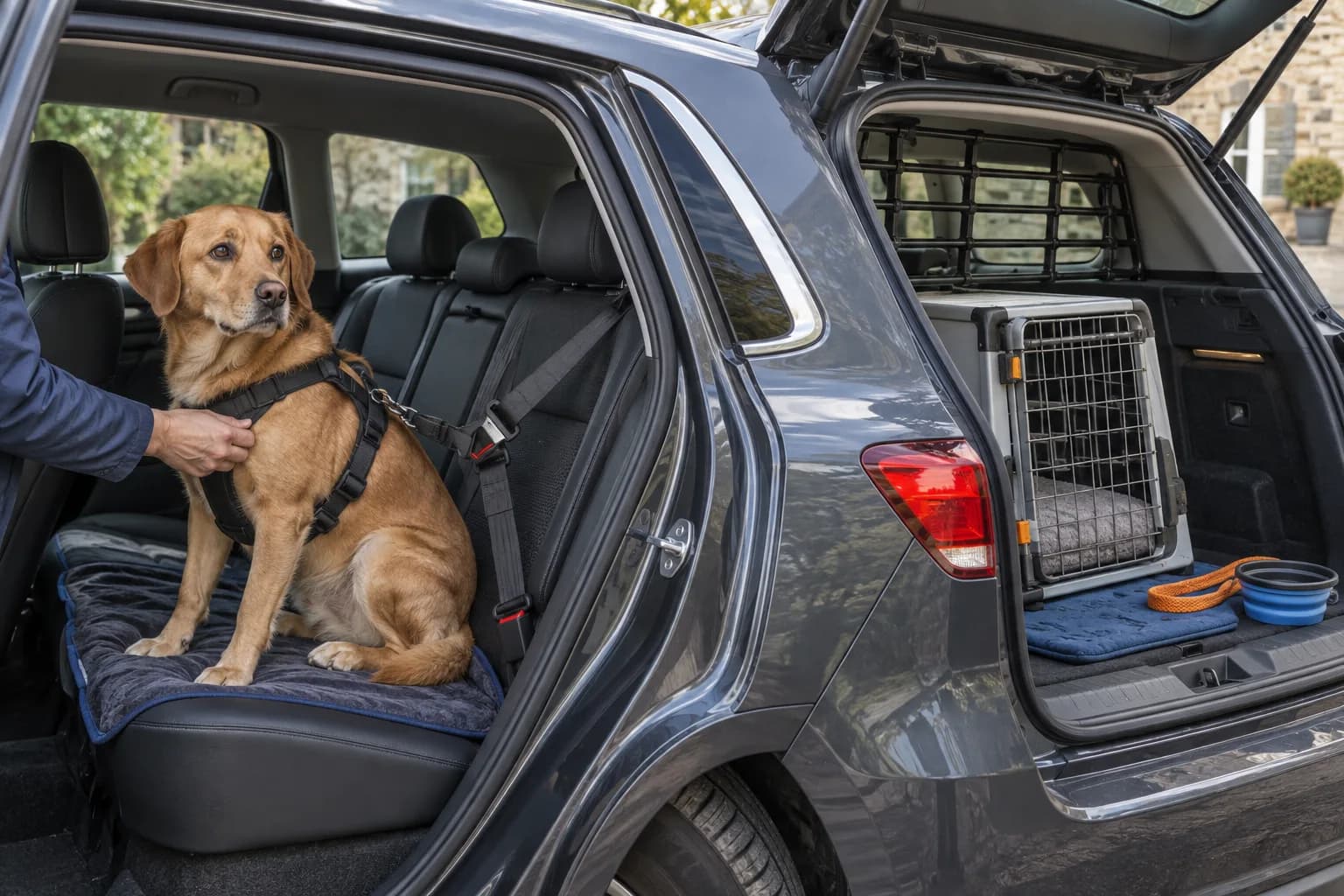
A dog happily sitting on a blanket can look perfectly settled—right up until a hard stop. In a car, “stays in the back” is not the same thing as “restrained”. The useful questions are how the product attaches to the vehicle, how it controls the dog’s body and what, exactly, its testing claim means.
That distinction gets lost in a market full of dog seats, tethers, guards and harnesses that can look equally reassuring in a photograph. Some primarily stop a dog wandering towards the steering wheel. Some contain hair and mud. A smaller number publish enough evidence to support a stronger claim about what happens under collision forces. Those jobs overlap, but they are not interchangeable.
This guide is designed to help you make a defensible choice for your own dog and car. It cannot promise an injury-free crash—no responsible restraint guide can—but it can show you which evidence deserves weight, which measurements matter and where attractive convenience features should sit in the decision.
What does the Highway Code say about dogs in cars?
Highway Code Rule 57 says dogs and other animals should be suitably restrained so they cannot distract the driver or injure themselves or people if the vehicle stops quickly. It names a seat-belt harness, pet carrier, dog cage or dog guard as possible methods. The rule is about suitable restraint, not a licence to assume that any item using one of those labels is equally protective.
That is the floor, not a product award. A flimsy tether may limit roaming without offering meaningful collision protection, and a guard may protect the driver from distraction without controlling the dog inside a large boot. We therefore separate independent certification from a manufacturer’s named test, and both from a basic anti-distraction device. If a listing says only “safety tested” but does not name the standard, laboratory, configuration, dog weight or pass criteria, the phrase tells you remarkably little.
Rule 57 is also not the only consideration after a collision. An unrestrained animal can injure passengers, escape through a broken door or prevent emergency services reaching the cabin safely. Whichever format you use should allow secure everyday loading and a realistic emergency release—not depend on a tiny clip nobody can reach once luggage has shifted.
Our short answer: Sleepypod Clickit Sport Plus is the strongest harness choice on published independent evidence. Thule Allax is the premium boot-crate option for a compatible vehicle. PDSA’s Car Safe is the more affordable harness, with a clearer published test limit than many generic tethers.
The best dog car restraints in the UK
Pick 1 · best independently certified harness
Sleepypod Clickit Sport Plus
This is the harness we would investigate first when collision evidence matters more than price or convenience. Its three-point design uses the vehicle’s own seat belt and broad webbing to help control the dog’s torso, rather than relying on a narrow tether behind one shoulder. The current model carries a five-star certification from the independent Center for Pet Safety, and Sleepypod publishes the relevant size ranges, test standards, videos and fitting instructions. That transparency gives an owner considerably more to examine than the phrase ‘crash tested’ on its own. It also works as a walking harness once the journey is over, avoiding a roadside change of equipment.
Keep in mind: This is not a buy-by-breed product. The fit is deliberately close, the seat-belt route takes practice and the smallest size has a lower CPS-certified weight range than the larger models. Measure around the widest part of the rib cage, compare that figure with the current chart, and follow the instructions supplied with the exact model rather than an older Clickit video. A dog between sizes or outside the published certification range needs another solution. UK stock and colours can be intermittent, and the structure is more substantial than an everyday lightweight walking harness, so introduce it before the first long journey.
Pick 2 · best premium boot crate
Thule Allax
For owners with a compatible estate car or SUV, the Allax is a serious vehicle crate rather than a wire home crate placed in the boot. Thule says it has been tested in front and rear impacts and a simulated rollover, and states TÜV SÜD certification using named ECE R17 and ECE R129-based methods. Its depth can be adjusted to suit the load space while retaining the designed crumple zone, and ten UK sizes give a better chance of matching both dog and vehicle than a universal box. Features such as the gas-damped door, escape hatch and built-in lock are thoughtfully aimed at daily travel, but the central reason to shortlist it is the published construction and test information.
Keep in mind: The price, weight and amount of measuring involved make this a considered purchase. Use Thule’s vehicle-fit tool, measure the dog standing and sitting, check the boot opening as well as its floor, and preserve the clearance required for the crate’s crumple zone. Too small compromises welfare; unnecessarily large leaves more space for the dog to be thrown inside. The crate must be secured with the specified equipment and cannot share boot space casually with loose luggage. Also consider whether you can lift it, remove it when needed and reach the emergency exit after a collision. A premium crate fitted badly is not a premium safety system.
Pick 3 · best more affordable harness
PDSA Car Safe Harness
This padded car-to-walk harness is a more attainable step up from a collar clip or anonymous buckle tether. It threads into the car’s seat-belt system, spreads contact across the chest and is sold in four sizes with actual measurements rather than broad breed labels. PDSA publishes a restraint test limit of up to 32kg and describes the product as crash-test certified, giving shoppers a defined claim to check. The reflective trim and walking lead attachment make it practical at the other end of the journey. For a dog within the stated range, it offers clearer information and a more appropriate body connection than many inexpensive marketplace restraints.
Keep in mind: Its evidence is not equivalent to Sleepypod’s current independent CPS listing, and we would not blur that distinction to create a neater ranking. The stated 32kg ceiling excludes heavier dogs, while a dog under that limit still needs to fit the chest and neck adjustment correctly. Confirm the current size chart and test wording on the seller page, route the vehicle belt exactly as shown and never substitute the walking attachment point for the instructed car connection. Check that padding has not hidden a twisted strap and that the dog can settle without gaining enough slack to climb into the footwell.
How we chose
This is a research-led safety comparison, not our own crash test. We checked attachment method, sizing, stated test protocol, independent certification, published weight limits, vehicle compatibility and the quality of the installation information. We did not award safety points for a soft bed, cup holder or elevated view: those may make a journey nicer but do not establish restraint performance.
We gave the most weight to claims an owner can interrogate. A named independent certifier, defined test standard and public size range are more useful than an unexplained badge. Manufacturer testing can still be meaningful—particularly for a vehicle-specific crate—but it must be described accurately and not quietly presented as independent approval.
The Center for Pet Safety says its certified programme uses independently developed standards, does not accept manufacturer funding and publishes qualifying products. We checked its current list rather than assuming every product described online as crash tested is independently certified. Absence from that list does not prove a product will fail; it means we cannot award it that particular evidence distinction.
Finally, we judged the restraint as a system. Strong hardware cannot compensate for the wrong size, an unapproved extension or a vehicle connection used differently from the test configuration. Our shortlist deliberately includes two harness evidence levels and one boot crate, so the differences remain visible rather than being flattened into a generic top ten.
Dog car restraints compared
| Product | Restraint type | Evidence distinction |
|---|---|---|
| Sleepypod Clickit Sport Plus | Rear-seat three-point harness | CPS five-star certified; maker publishes multiple test standards |
| Thule Allax | Anchored boot crate | Maker crash tests; TÜV SÜD certification stated for named methods |
| PDSA Car Safe | Seat-belt harness | Seller states crash-test certification and a 32kg limit; not on current CPS list |
Harness, crate, carrier or dog guard?
A car harness suits many back-seat travellers
A genuine car harness spreads load across a broader chest area and attaches as the maker instructs. It can suit owners who change cars, lack a suitable boot or need the rear load space for luggage. The dog remains visible and the better designs double as walking harnesses, although that convenience is secondary to their restraint construction.
A short lead clipped to a collar is not an alternative: sudden force concentrated at the neck can cause severe injury. Nor should you create your own system from an everyday harness, an extension tether and a buckle clip simply because every part feels strong in the hand. Compatibility, belt route and available travel are part of the tested configuration. Adding slack for comfort can create a longer acceleration path before the restraint engages.
A fitted crate can be the stronger boot solution
A purpose-designed vehicle crate controls the dog’s space, separates them from occupants and may make loading a crate-trained dog calmer. Rigid construction can also protect against shifting luggage. Its benefit depends on the complete installation, however: an unsecured household wire crate in a large boot is not equivalent to a vehicle crate anchored and tested as a system.
Check the vehicle-fit guide, boot opening, anchor points, emergency access and clearance around any designed crumple zone before spending several hundred pounds. The dog should be able to stand, turn and lie naturally, without so much empty space that the animal travels a long distance within the crate during a sudden stop. If two dogs share the boot, use only a divider or arrangement the manufacturer permits.
A guard mainly creates separation
A well-fitted guard can stop a dog climbing into the passenger area and distracting the driver. That is useful, especially in a tall boot, and Rule 57 names dog guards among possible restraint methods. A model shaped and secured for the vehicle is preferable to a loose pressure-fit barrier that can shift during ordinary driving.
It should not automatically be treated as collision protection for the dog. In a large load space, the animal may still be thrown against the boot, luggage or guard unless another suitable restraint controls movement. Ask what the guard is intended to do, how it fixes to the car and whether the maker publishes any load or impact testing before attributing more protection than it claims.
A booster seat is not automatically a safety restraint
Small dog car seats can provide height, comfort, a washable surface and a defined place to settle. Those are legitimate benefits for some dogs. Judge the restraint separately: how is the seat fixed to the vehicle, how is the dog connected, and is that connection designed and tested for collision loads at the dog’s weight?
A thin internal strap may prevent jumping out without protecting the body in a crash. Never clip a car tether to a collar, and do not assume an ISOFIX-style marketing phrase establishes a complete tested system. If the seat’s evidence is unclear, treat it as comfort equipment used alongside an appropriate restraint rather than as proof of crash protection.
Fit and installation matter as much as the label
- Measure the right places: follow the maker’s diagram around the rib cage, neck or body length. Weight alone rarely describes shape, and guessing from breed is especially unreliable for crosses.
- Check every adjustment: the harness should be secure without restricting breathing or shoulder movement. Recheck it after the dog changes coat, weight or body condition.
- Use the named connection: route the vehicle belt, anchors and accessories exactly as instructed. Do not add an extension, swivel or spare clip for convenience unless the maker approves it.
- Control useful space: leave enough room to sit or lie naturally without creating a long launch distance. Remove hard toys and loose bowls that can become projectiles.
- Secure everything else: luggage sharing the boot or rear seat needs restraint too. A tested dog crate cannot protect against a suitcase moving freely beside it.
- Inspect before travel: look at straps, stitching, buckles, crate fixings and vehicle contact points. Sand, chewing and trapped webbing can weaken or prevent correct operation.
- Follow replacement advice: retire a restraint after a collision when the maker instructs, even if damage is not obvious. Do not buy used safety equipment with an unknown history.
- Practise emergency release: every regular driver should know how to free or move the dog, and a spare lead should be reachable rather than buried under luggage.
Introduce the restraint before you need it
Let the dog investigate a harness or stationary crate away from the pressure of departure. Reward voluntary approach, then build from brief fastening to sitting in the parked car, engine-on sessions and very short journeys. A favourite mat may help if it does not alter the belt route or interfere with crate fittings. Never leave a dog tethered in a parked car while you practise elsewhere.
If your dog pants, drools, vomits, panics or struggles persistently, do not simply shorten the tether until movement stops. Travel sickness, pain and fear need different responses. Speak to your vet about physical symptoms and seek a suitably qualified behaviour professional for a gradual plan where anxiety is involved. A technically sound restraint still needs a humane introduction.
Common questions
What is the safest dog car restraint?
There is no universal winner for every dog and vehicle. A certified harness that fits one medium dog correctly may be unusable for a dog outside its weight range, while an excellent crate may not fit the vehicle’s boot or required crumple-zone clearance. Start with independently certified products or clearly named test methods, then verify the exact dog, size, car and installation.
Published evidence is the best differentiator available to a shopper, but correct use remains part of safety. Read the current manual before purchase, not after, and reject any option that requires an improvised connector or uncomfortable fit to work in your car. If your dog has a medical or mobility condition, ask your vet how the restraint’s pressure areas and loading method affect them.
Is a dog seat belt clip enough?
A clip can restrict roaming and reduce driver distraction, but its performance depends on the buckle, tether, stitching, harness and attachment point working as a complete system. A familiar-looking metal clip does not reveal the force it can withstand, and a long elastic tether may allow substantial movement before it reaches full length.
Most importantly, a generic strap clipped to a collar is not appropriate collision protection. If you choose a harness, use only the vehicle connection and accessories specified for that model. Do not assume a universal buckle fits securely merely because it clicks into the socket; buckle geometry and vehicle instructions vary.
Can my dog travel in the front seat?
The rear is generally the more sensible location because front airbags and proximity to the controls introduce additional risks. A dog must never obstruct the steering wheel, gear selector, pedals or the driver’s view. Do not disable safety systems or move a seat solely on the basis of generic internet advice.
If front-seat travel is unavoidable, consult both the vehicle handbook and the restraint manufacturer for that exact arrangement, including airbag guidance. The absence of an explicit warning is not the same as approval. A pet carrier or harness also needs to remain secure during entry and exit so the dog cannot step directly into traffic.
Can two dogs share one crate or seat-belt point?
Only if the manufacturer explicitly designs and approves that configuration. Two dogs can collide with one another, become tangled or place forces on a divider and anchor in ways a single-dog test never covered. Separate correctly sized restraints are the clearer default, with enough distance that belts and leads cannot cross.
Do I need to replace a harness after a crash?
Follow the manufacturer’s post-collision instructions. Webbing, stitching or hardware can be damaged without an obvious surface break, much like other safety equipment. Record the model and purchase details somewhere accessible, inspect it after any severe stop or impact, and do not pass on equipment whose collision history a future owner cannot know.
Sources checked
We checked Highway Code Rule 57, the Center for Pet Safety certified list, and current specifications from Sleepypod, Thule and PDSA on 27 September 2026.