Buying guides
Best tick removers for dogs UK: hooks, cards and pens compared
The best tick tool is small, purpose-made and already within reach. Here is what to keep at home, in a walking bag and with a dark-coated dog.
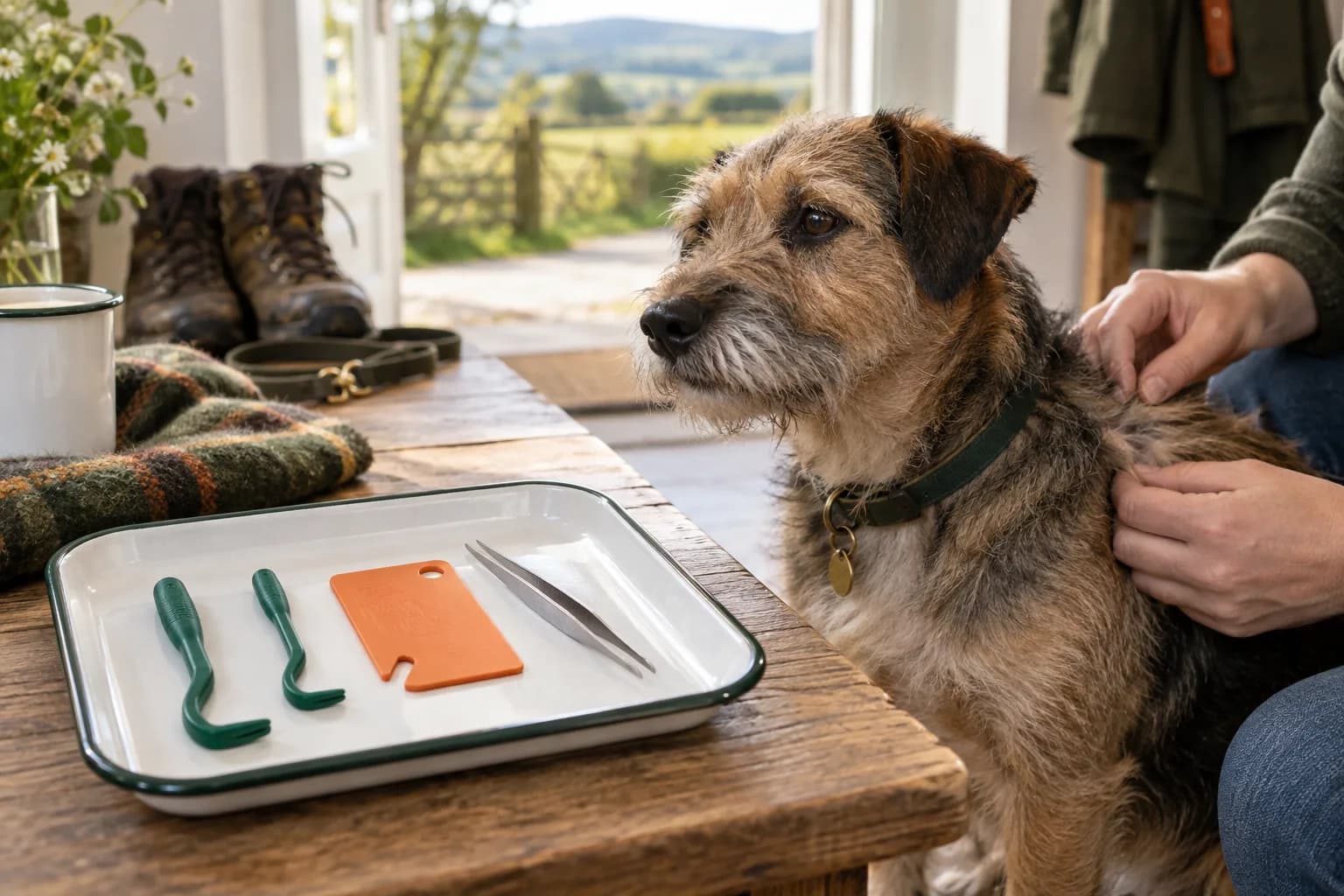
A tick remover is the sort of object that looks absurdly insignificant—until you are kneeling in the hallway, parting damp fur and wishing you knew where you put it. The tool itself costs little; having the right shape, a steady hand and enough light when a tick is attached is what matters.
Buy a purpose-made tool before you need one, read its instructions in an unhurried moment and keep it somewhere memorable. If your dog regularly walks through heath, woodland, moorland or long grass, keeping a second tool in the car or walking bag is not excessive. It is the practical equivalent of carrying spare poo bags.
Our short answer: an O’Tom Tick Twister set is the best all-round choice because multiple hooks handle different tick sizes with very little mechanical complexity. Add a Lifesystems card to a wallet or walking pack when portability is the priority. For dark, dense coats, Trixie’s illuminated pen tackles the very real problem of seeing the attachment point clearly.
The best tick removers for dogs
Pick 1 · best all-round remover
O’Tom Tick Twister
O’Tom’s set includes differently sized hooks so the fork can slide beneath anything from a small newly attached tick to a larger engorged one without gripping the swollen body. The maker’s method—approach from the side, lift very slightly and rotate—matches the twisting-tool technique described by PDSA. There are no hinges, springs or batteries to fail, and the bright little hooks are easy to wash and distribute between a home first-aid box, car kit and walking bag. That combination of simple design and clear technique makes this our first choice for most dog owners.
Keep in mind: The tool is simple, but the moment may not be: dense fur, a sensitive site and an impatient dog can make access difficult. Choose the hook that fits closely beneath the tick, read the illustrated instructions before you need them and do not substitute an upward yank for the intended rotation. The hooks are small enough to lose, so keep the set in its clip or a labelled pouch rather than loose in a drawer.
Pick 2 · best for a wallet or hiking pack
Lifesystems Tick Removal Card
The standard card is 85 × 54mm, just 1mm thick and weighs 6g. It includes two different slot sizes and a small magnifying lens, turning a piece of equipment you might leave at home into something that can live permanently in a wallet or map case. Lifesystems also makes a smaller key-ring version. For walkers, campers and owners who travel with their dogs, availability at the moment of discovery is a genuine performance feature: the finest tool in the bathroom cabinet is no help halfway across a moor.
Keep in mind: A flat card needs room to approach along the skin, so it can be awkward beside an eyelid, deep in an ear flap, between toes or in a tightly furred armpit. The magnifier is helpful for inspection but does not illuminate dark skin. Treat this as the most portable option, not a universal replacement for a curved hook or veterinary help in difficult locations, and protect the thin card from becoming bent or cracked in an overfilled pack.
Pick 3 · best for dark or dense coats
Trixie Tick Remover Pen with LED
With a dark-coated or double-coated dog, locating the attachment point can take longer than the removal itself. Trixie’s 14cm pen adds a small LED directly beside the gripping end, helping the owner part the coat and see where tick meets skin. A pocket clip keeps the pen accessible on a walking or grooming bag, and the longer body offers more to hold than a thumbnail-sized hook. It is a thoughtful specialist choice when visibility and reach are the recurring difficulties.
Keep in mind: The pen has more parts than a moulded hook and uses an SR41 battery, so check the light periodically rather than discovering a flat battery after a walk. The maker instructs users to grip with the clamp and remove with an upward movement, which differs from the rotating action of O’Tom hooks. Do not mix techniques between tools: keep the Trixie instructions with the pen and practise operating it away from the dog first.
How we chose
This is a research-led comparison of published design, dimensions and instructions; we did not remove live ticks with these tools. We looked for more than clever packaging: multiple sizes, control close to the skin, portability, cleanability, visibility and directions that can be followed without squeezing the tick’s body.
We compared the manufacturer’s technique with current guidance from PDSA, Blue Cross and ESCCAP UK & Ireland. A tool did not receive credit merely for claiming to reduce infection risk; we wanted to see how it approached the tick and whether an owner could choose the right size and movement.
We excluded chemical tick treatments from this list. Prevention matters, but the right product depends on the dog, household, location and travel risk and is better discussed with a veterinary professional. Some dog tick treatments can be dangerously toxic to cats, which is another reason not to turn a remover comparison into casual medication advice.
Finally, we considered whether the tool would actually be present. A wallet card can be a better purchase for a long-distance walker than a marginally easier tool left at home. Many owners will sensibly choose two inexpensive formats for different kits and body sites.
Tick removers compared
| Tool | Useful feature | Best place to keep it |
|---|---|---|
| O’Tom Tick Twister | Several hook sizes; simple twist action | Home first-aid kit |
| Lifesystems card | 6g wallet format; magnifier; two slots | Wallet or hiking pack |
| Trixie LED pen | Light helps locate ticks in dark, thick fur | Dog walking bag |
How to remove a tick from a dog
PDSA advises sliding a correctly sized tick-twisting tool under the tick, as close to the skin as possible. Turn the tool in one direction without pulling upwards until the tick loosens, then lift it away slowly. Clean the area and monitor your dog.
- Set up before touching the tick. Find good light, disposable gloves if available, the instructions, a way to contain the removed tick and a reward for the dog.
- Part the fur gently. Ask another adult to offer calm support if needed. Do not pin down a frightened or painful dog and risk a bite.
- Identify the tick’s body and attachment point. Be certain it is a tick rather than a skin tag, nipple or lump. If unsure, stop and ask your vet.
- Select the right tool or size. A hook or card slot should pass close to the skin beneath the tick without compressing its abdomen.
- Follow that tool’s instructions. Twisting hooks rotate; other clamps or fine tweezers may use a different controlled movement. Do not mix the methods.
- Inspect the removed tick and skin. Check that the tick appears complete, but do not dig into the skin with a needle if a dark speck remains.
- Contain and dispose of it safely. Do not crush it between bare fingers or leave it able to attach to another animal or person.
- Clean and record. Wash your hands, clean the bite area as advised, note the date and location, and monitor the dog.
A photograph before and after removal can be useful if the site later becomes inflamed or your dog becomes unwell. It records the location and appearance without requiring you to keep a live tick loose in the house.
If the tick is beside an eye or inside an ear, your dog will not stay still, part remains in the skin, or the site becomes inflamed, ask your vet for help. See our vet-reviewed guide to ticks and tick-borne disease in the UK for the wider picture.
What not to do
Do not squeeze, crush, burn or smother an attached tick with oil, alcohol, petroleum jelly or essential oils. ESCCAP UK & Ireland advises prompt removal with a proprietary device and specifically says oil, alcohol and ether should not be used. Improvised methods can make controlled, complete removal harder and may increase handling of the tick’s body.
Do not keep probing the bite with sharp household tools if part appears to remain. PDSA advises a veterinary check when mouthparts have been left behind because inflammation or infection can develop. Likewise, do not postpone removal for days while waiting for a preferred brand to arrive; ask a vet practice for help if you cannot obtain or confidently use a suitable tool.
Aftercare: what deserves a veterinary call?
A small mark may remain after removal, but increasing heat, redness, swelling, pain or discharge warrants advice. Contact your vet if your dog becomes lethargic, feverish, lame, loses appetite or seems unwell after a tick bite. These signs are not specific to tick-borne disease, which is precisely why an examination matters.
Ticks should also prompt a prevention review. Record where the dog may have picked it up, check the whole coat and other pets, and ask your veterinary team whether the existing prevention plan still suits the dog’s activities and travel.
Common questions
Is a tick hook better than tweezers?
For many owners, a correctly sized twisting hook makes it easier to pass beneath the tick and avoid squeezing the body. The different hook sizes also make the choice more obvious when a tick is tiny or engorged.
Fine-point tweezers can be used carefully, but ordinary blunt eyebrow tweezers may grip the swollen abdomen rather than the mouth area. Follow the removal method for the tool you have; a hook and tweezers are not used identically.
Do I twist clockwise?
With a twisting hook, the direction matters less than turning smoothly in one direction and following the manufacturer’s instructions. Do not reverse repeatedly or tug straight upwards because the tick has not released after the first movement.
Not every tool twists: the Trixie pen, for example, has its own clamp-and-lift directions. Keep instructions with the device so that several people in a household use it consistently.
Should I save the tick?
You can take a clear photograph or retain the tick in a securely sealed container if your vet or a surveillance scheme asks. Do not leave it able to crawl onto another host and do not handle it with bare fingers.
More important than keeping it indefinitely is recording the date, likely exposure area and bite location. Seek veterinary advice if the site becomes inflamed or the dog becomes unwell.
How often should I check my dog?
Run your hands over the coat after walks in tick habitat, paying close attention to the face, ears, neck, armpits, groin, skin folds and between the toes. Small ticks can feel like grit or a tiny seed before they become visibly engorged. ESCCAP recommends regular thorough coat examinations and prompt removal with a proprietary device.
When is tick season in the UK?
Ticks are often more active in milder, humid conditions, so owners commonly notice them from spring into autumn. That is a useful reminder, not a safe calendar boundary: regional weather, habitat, wildlife and increasingly mild winters mean exposure can occur outside the traditional season. Woodland, heath, long grass and areas used by deer or livestock deserve particular attention, but a garden or urban fringe is not automatically tick-free.
Make the check proportionate to the walk rather than the month. Run your fingertips through the coat after higher-risk routes and look closely around the head, ears, neck, armpits, groin, between toes and beneath collars or harness straps. Long or dense coats take more patience. Ask your vet for parasite-prevention advice tailored to where your dog walks, travels and lives; a removal tool is useful first-aid equipment, not a replacement for an individual prevention plan.
Sources checked
We checked product instructions from O’Tom, Lifesystems and Trixie, plus guidance from PDSA and ESCCAP UK & Ireland, on 27 September 2026.